

MotoGP is synonymous with technology. Mechanical and motor technology, of course, but also digital. Whether during the development of the bike or on the track, as we had the opportunity to highlight during our visit to Mugello. For 2024, the Ducati Lenovo Team will bring further technological innovations to the pit box that will also leverage artificial intelligence.
Lenovo and Ducati: a winning collaboration
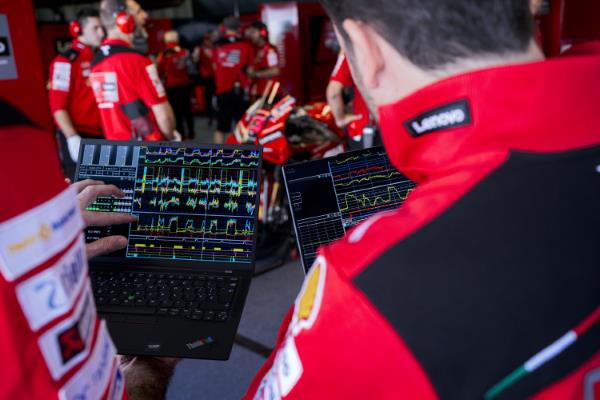
The collaboration between Lenovo and Ducati has been ongoing since 2018, and in 2024, it is further renewed. The solutions provided by the multinational are fundamental to ensuring success during races: every race weekend, Lenovo platforms collect around 100 GB of data from the 50 sensors equipped on each of the eight Ducati Desmosedici GP bikes participating in the championship. This data needs to be quickly analyzed on-site. This task falls to the Lenovo ThinkSystem SE350 edge servers, which in 2024 will be complemented by the Lenovo ThinkAgile hyper-converged infrastructure (HCI). This platform is optimized for calculations related to machine learning and deep learning, key technologies to help engineers analyze a vast amount of information very quickly.
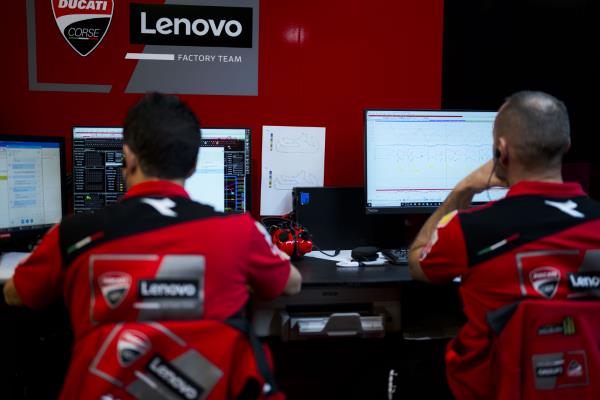
As in previous years, edge servers are not the only resource available to engineers, who can also rely on the Ducati Lenovo Remote Garage. The data acquired during tests and races will be sent in real-time to Ducati’s headquarters in Borgo Panigale, where other engineers will remotely collaborate with those present at the track. For 2024, the dedicated Remote Garage room has been updated with new servers and monitors, provided by Lenovo, of course.
Lenovo has also provided the HPC that Ducati uses for computational fluid dynamics (CFD) simulations crucial for the development of the bikes. The supercomputer in question is based on Lenovo ThinkSystem SD530, SR630, and SR650 servers. If the computing power is not sufficient, it can be further expanded by leveraging the multinational’s cloud resources.
A robot for track scanning. And for the future…
To ensure reliable simulations, a solid database is crucial, including those related to the circuit. That’s why starting in 2024, a new technology for track surveys will make its debut: an autonomous driving robot that will traverse the track at the beginning of race weekends, acquiring every detail of the asphalt through LiDAR sensors. A ThinkStation P360 Ultra workstation will be responsible for collecting and analyzing the data obtained. The system can acquire around 2.6 million data points per second from the sensors, approximately 200 GB for each track.
Lenovo and Ducati have not disclosed their plans for the future, although they have confirmed interest in experimenting with AR and VR, technologies that could also help from an environmental sustainability perspective.
“It is with great passion that we begin a new MotoGP Championship with Ducati Corse, after a successful 2023 season that showcased progress in both technology and on-track performance, culminating in the prestigious achievement by Francesco Bagnaia securing the MotoGP World Riders’ Championship for the second consecutive year. The competition will be tough, and we are excited to continue working with the team, providing our technology and innovative services to further raise the performance bar. The goal is not only to compete for the title but also to make the technological advancements developed on the track accessible to everyone, such as for Ducati’s road bikes,” comments Luca Rossi, President, Intelligent Devices Group at Lenovo.


